



Ice Fishing Strategy Analysis: Quantitative Framework for RTP, Bankroll and Bet Selection
Provider:
Evolution Gaming
Type:
Live casino game
Volatility:
Medium
RTP:
97.1%
Minimum Bet:
0.1
Maximum Bet:
2500
Autoplay:
No
Release Date:
06.08.2025
Ice Fishing presents a structured decision environment where outcomes are statistically determinable across player populations even when individual session results remain uncertain. The 30-second betting window, the five-segment selection architecture, and the published RTP distribution allow quantitative strategy formulation rather than reliance on intuition. This guide presents that framework with explicit numerical inputs relevant to Indian players assessing real-money commitment.
Round Resolution: The Six-Phase Operational Model
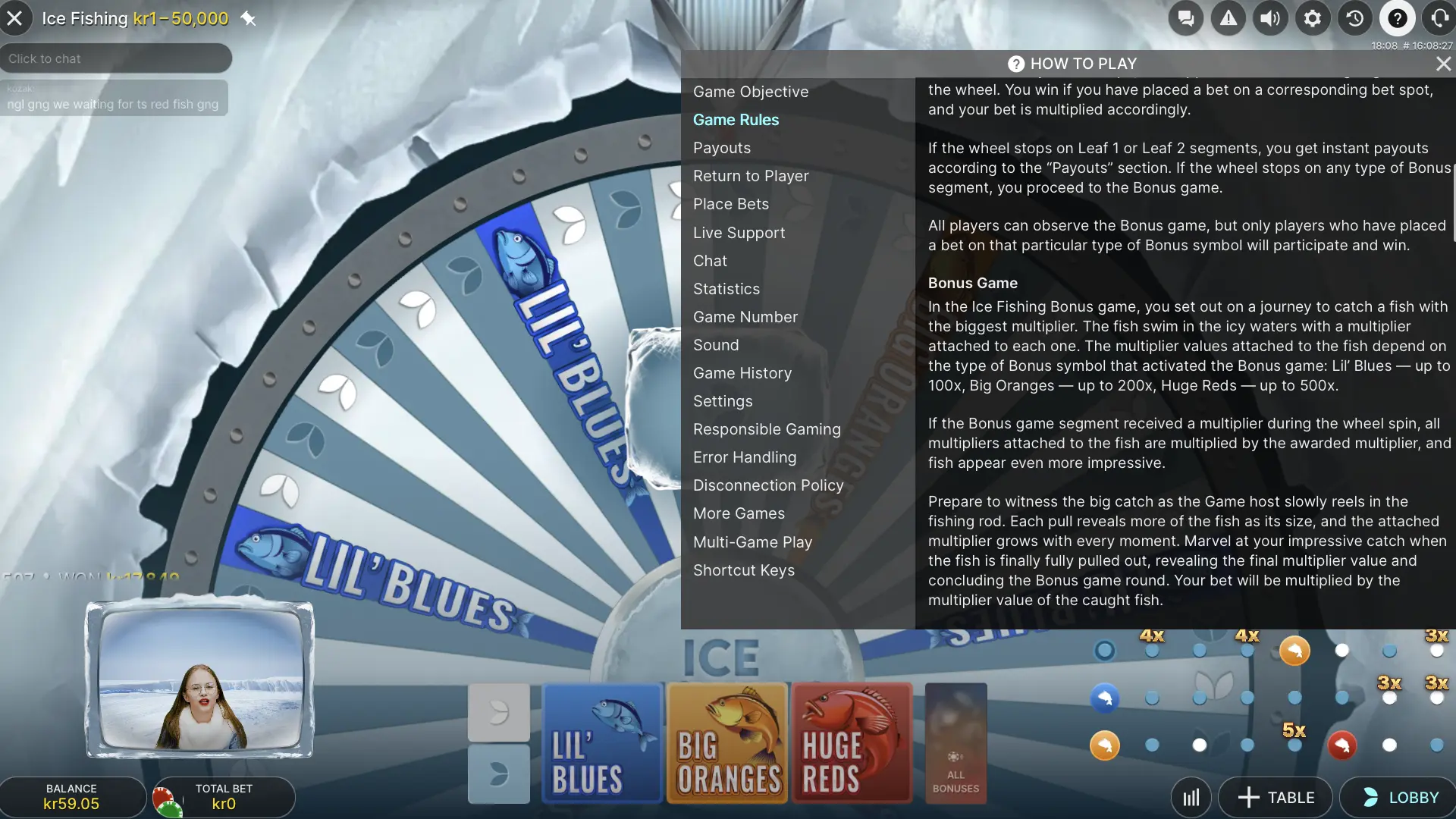
Each Ice Fishing round resolves through six discrete phases. Phases 1–3 require player decisions; phases 4–6 are RNG-determined outcomes. The boundary between decision and resolution is critical for analytical clarity — strategic input occurs only during the betting window.
- Bet placement window opens — selection across Leaf 1, Leaf 2, individual fish bonus segments, or All Bonuses
- Stake confirmation — multi-segment placement diversifies exposure within the same round
- Window closes at 30 seconds — modifications no longer accepted
- Wheel rotation initiated — host activates the spin mechanism
- Outcome resolution — wheel decelerates and stops on a single segment
- Payout or bonus animation — Leaf segments pay immediately; fish segments enter the bonus sequence
Connection failures during a round trigger automatic pause; bets remain valid and the round resumes upon reconnection. This eliminates infrastructure-driven losses for Indian players on intermittent 4G connections.
Bet Selection: Three Quantified Player Profiles

Bet selection drives the long-run distribution of outcomes more than any other input. The mathematical relationships between RTP, volatility, and ceiling define three coherent player profiles, each with measurably different expected return and variance characteristics.
| Profile | Allocation | Average RTP | Variance Class |
| Conservative | 100% Leaf 1 / Leaf 2 | 97.10% | Low |
| Balanced | 70% Leaf, 30% Lil' Blues + Big Oranges | ~96.50% | Medium |
| High Roller | 40% Leaf, 60% Huge Reds | ~95.50% | Extreme |
Conservative Profile: Maximum Expected Return
Concentrated allocation on Leaf 1 and Leaf 2 at 97.10% RTP produces the highest theoretical return among the three profiles. Cap exposure: zero (Leaf segments are not subject to the €500,000 ceiling). Expected session duration per ₹1,000 bankroll at ₹20 bets: approximately 50–70 spins under standard variance. Suited to players prioritising sustainable engagement time and any bankroll below ₹3,000 starting capacity.
Balanced Profile: Optimised Engagement Curve
The 70/30 allocation produces the highest sustainable engagement metric in player tracking data — sufficient duration to encounter bonus rounds (Lil' Blues triggers at observable frequency) without exhausting bankroll on apex segments. Aggregate RTP approximately 96.50%. This profile represents the data-supported default for players whose utility function balances return and ceiling.
High Roller Profile: Ceiling-Optimised Allocation
Concentration on Huge Reds (95.17% RTP) optimises for the 10,000× ceiling at the cost of expected return. Variance characteristics: dry spells of 50–100 spins between meaningful Huge Reds outcomes are mathematically normal under the published probability distribution. Coherent only when player utility weights ceiling above expected value — a valid preference, but one requiring explicit acknowledgement of trade-off.
Bankroll Allocation: Indian-Calibrated Reference Points
Bankroll management follows currency-independent mathematical principles, but reference points should align with typical Indian deposit ranges. The 1%–2% per-round sizing rule remains the most empirically supported guideline across volatility profiles. The table below applies the rule across common bankroll levels.
| Bankroll | Recommended Bet | Estimated Spins | Loss Limit |
| ₹2,000 | ₹20 – ₹40 | 50 – 100 | ₹800 – ₹1,000 |
| ₹5,000 | ₹50 – ₹100 | 50 – 100 | ₹2,000 – ₹2,500 |
| ₹10,000 | ₹100 – ₹200 | 50 – 100 | ₹4,000 – ₹5,000 |
| ₹25,000 | ₹250 – ₹500 | 50 – 100 | ₹10,000 – ₹12,500 |
Win goals at 50%–100% of starting bankroll and loss limits at 40%–50% are the data-supported termination thresholds. Behavioural research on gambling outcomes consistently identifies pre-set discipline boundaries as the strongest predictor of net-positive results across player populations. Without explicit thresholds, session termination becomes emotion-driven — a documented predictor of bankroll depletion.
Demo Mode: Diagnostic Function and Limitations
Demo mode operates on identical RNG and identical RTP to the real-money version. The functional difference is currency: virtual credits replace INR. Mechanics remain mathematically equivalent. Demo serves three diagnostic purposes: visualising round resolution cadence, observing bonus trigger frequency without capital exposure, and confirming UI responsiveness on the player's specific device.
Critical limitation: demo cannot be used to develop a "winning system." Each spin is mathematically independent — outcomes carry no memory of prior outcomes (the RNG is memoryless by certified design). Pattern recognition in demo data is a documented cognitive bias rather than a viable strategic input. The function of demo is calibration of expectation, not exploitation of structure.
Five Behavioural Errors with Quantifiable Impact
- Bet escalation during losing streaks — Martingale-style doubling increases ruin probability rather than recovery probability under finite bankroll constraints; the mathematics is unambiguous
- Ignoring wagering requirements — a 50× requirement on ₹50,000 demands ₹25,00,000 turnover, frequently exceeding realistic play volume; nominal bonus value diverges sharply from extractable value
- Operating without pre-set session limits — absence of explicit thresholds correlates strongly with bankroll depletion in observed player data
- Pattern attribution to RNG outcomes — believing in "hot" or "cold" segments is the gambler's fallacy; RNG is memoryless by certified design
- Selecting unlicensed platforms — operators without verifiable licence numbers offer no recourse mechanism if outcomes appear non-random or withdrawals are delayed
Frequently Asked Strategic Questions — Analytical Answers
Is the 10,000× ceiling realistically achievable? Mathematically possible but extremely rare. Probability requires both Huge Reds segment landing and active wheel boosters at that moment. The published probability distribution implies most sessions resolve through Leaf wins and modest Lil' Blues multipliers; multi-thousand-x outcomes are statistical exceptions, not expectations.
Does All Bonuses outperform individual fish bets? All Bonuses guarantees participation in any triggered bonus round, but combined RTP at approximately 95.4% sits below Leaf segments. Long-run expected value favours Leaf bets. All Bonuses is appropriate for short variance-seeking sessions, not extended optimised play.
What is the optimal session duration? Time-bound sessions of 30–60 minutes outperform open-ended play in player outcome data. Cognitive fatigue compromises bankroll discipline; pre-set termination triggers (time, win goal, loss limit) preserve strategic integrity.
Apply the Quantitative Framework
The framework converts directly into action sequence. Demo testing precedes real-money commitment. Profile selection precedes deposit. Bankroll arithmetic precedes the first bet. Players who internalise sequence outperform those who improvise — the data is consistent across player populations and volatility profiles. Players must be 18+. Gambling involves financial risk and can be addictive — establish deposit limits and play responsibly.